An atomic car for an atomic age
In the 1950s nuclear power looked like the future of everything. Ford’s designers asked what that would mean for the car.
A model, not a car. The Nucleon never existed as a full-size car, never had a reactor and never moved under its own power. What exists is a 3/8-scale model. Everything on this site is about that model and the idea behind it.
The atomic age
As early as 1945 the engineer William Stout, designer of the Ford Tri-Motor aeroplane and the Stout Scarab, predicted atomic-powered cars. Times Colonist (Bill Vance)
Motor Trend’s April 1951 cover promised “Tomorrow’s Atom Car!” Times Colonist (Bill Vance)
In 1954 the US Navy launched the first nuclear-powered submarine, USS Nautilus, and under President Eisenhower’s “Atoms for Peace” programme work had begun on America’s first nuclear power station, at Shippingport, Pennsylvania. Hemmings (Kurt Ernst)
Benson Ford, Henry Ford’s grandson, encouraged members of the Society of Automotive Engineers to design a nuclear-powered car. Times Colonist (Bill Vance) Ford already had an underground laboratory in Dearborn using radioisotopes to inspect metal. Times Colonist (Bill Vance)
A young designer’s idea
The design came from Jim Powers, then in his first year in Ford’s Advanced Studio. Alex Tremulis liked his sketches and encouraged him to develop the idea. Hemmings (Kurt Ernst)
That account comes from Jim and Cheryl Farrell’s book Ford Design Department Concepts and Showcars, 1932-1961, as retold by Hemmings. Hemmings (Kurt Ernst)
The model was built to explore how the future of energy might change the design of cars. The Henry Ford
Tremulis went on to bigger gyroscopic ideas. Alex Tremulis, who encouraged the Nucleon, later co-created the Gyro-X, a gyro-stabilised two-wheeled car of 1967. Lane Motor Museum It has a site of its own: the Gyro-X.
From sketch to model
The 3/8-scale model was made first in clay and then in fibreglass. Hemmings (Kurt Ernst)
It had a wraparound windscreen and a cantilevered roof with no front pillars. The only air intakes were at the top of the windscreen and at the foot of the rear roof pillars. Hemmings (Kurt Ernst) The model’s windows are painted black: clear ones would have needed a mocked-up interior, and neither was in the design budget. Hemmings (Kurt Ernst)
It was first finished in bright red, with a silver roof and silver lower panels. Hemmings (Kurt Ernst)
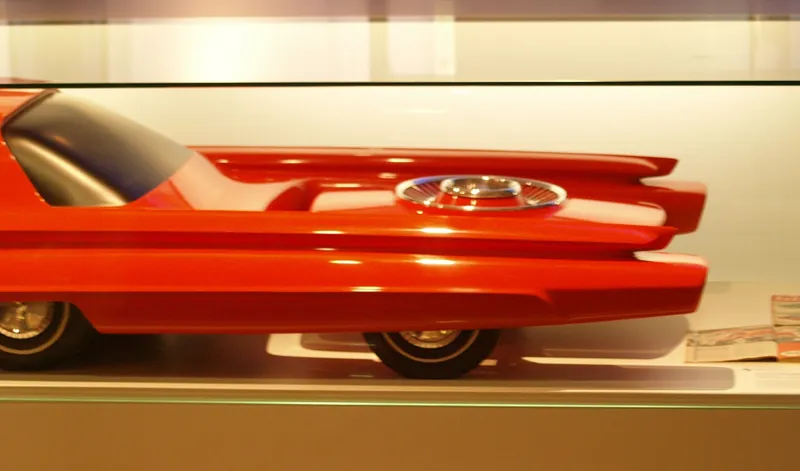
Ford said the design rested “on the assumption that the present bulkiness and weight of nuclear reactors and attendant shielding would someday be reduced.” Hemmings (Kurt Ernst)
Ford printed a brochure in 1958 called “Nucleon, a Glimpse into an Atomic-Powered Future”. A copy is kept at The Henry Ford’s Benson Ford Research Center. The Henry Ford (brochure)
Not the only one
Chrysler drew a nuclear car with its passengers well forward, but it never got past paper illustrations; Studebaker-Packard’s atomic dream car, the Astral, came to nothing too. Times Colonist (Bill Vance)
Bill Vance calls it the boldest move by any car company, even though it never got beyond the scale model. Times Colonist (Bill Vance)
Timeline
- 1945 As early as 1945 the engineer William Stout, designer of the Ford Tri-Motor aeroplane and the Stout Scarab, predicted atomic-powered cars. Times Colonist (Bill Vance)
- 1951 Motor Trend’s April 1951 cover promised “Tomorrow’s Atom Car!” Times Colonist (Bill Vance)
- 1954 In 1954 the US Navy launched the first nuclear-powered submarine, USS Nautilus, and under President Eisenhower’s “Atoms for Peace” programme work had begun on America’s first nuclear power station, at Shippingport, Pennsylvania. Hemmings (Kurt Ernst)
- 1958 The Ford Nucleon was Ford’s 1958 idea for a car powered by a rear-mounted, self-contained nuclear reactor. The Henry Ford Ford printed a brochure in 1958 called “Nucleon, a Glimpse into an Atomic-Powered Future”. A copy is kept at The Henry Ford’s Benson Ford Research Center. The Henry Ford (brochure)
- 1981 After its Rotunda days the public largely forgot it. Smithsonian Institution researchers rediscovered the model in 1981; Ford repainted it, in solid red with a silver roof, and it spent two years at the Smithsonian before going back to Ford. Hemmings (Kurt Ernst)
Next: how it would work →